WinnerScript Blog
From Murray's 20 Needs to Our 48 Instincts and Senses
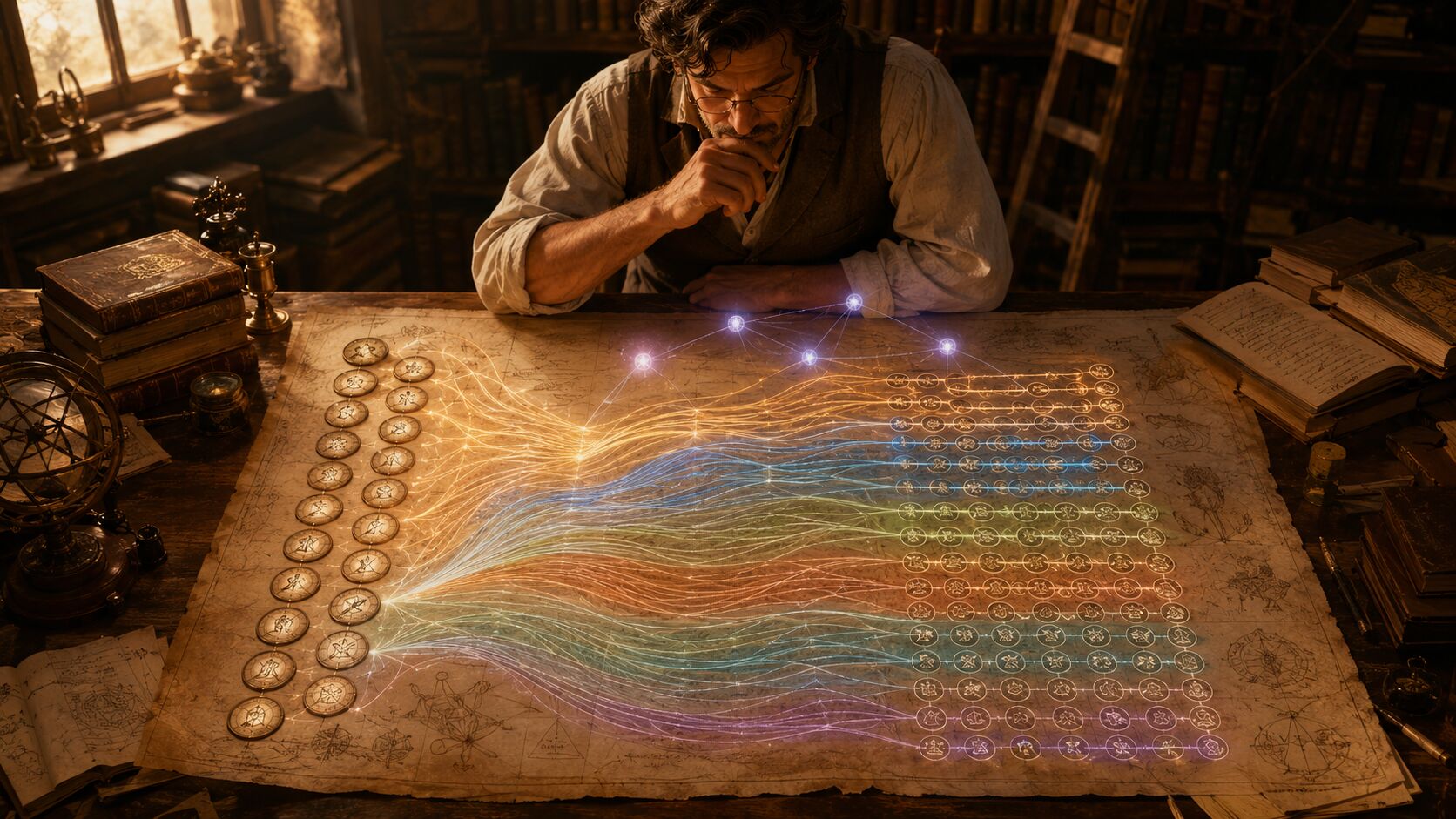
Nielsen and Kajonius (2024, Current Psychology) tested personality at three levels of detail: 5 broad factors, 30 facets, and 120 item-level nuances. In their sample of 440 people, broad factors explained 12% of variance in life outcomes, facets explained 22.5%, and nuances explained 34%. That is almost three times more predictive power when the map becomes more specific. A separate cross-national analysis by Rammstedt, Lechner, and Danner (2025) points in the same direction: across 11 countries, personality facets explained about 10% of variance in cognitive outcomes, while broad domains explained roughly 4-6%.
So maybe the old argument in personality science is quietly resolving.
Not in favor of fewer boxes.
In favor of better resolution.
That is the lineage WinnerScript comes from: Henry Murray's many-needs psychology, modern nuance research, and the stubborn suspicion that a human being is too alive to fit inside one clean label.
1938: Murray Makes the Field Uncomfortable
In 1938, Henry Alexander Murray published Explorations in Personality, a 761-page study of personality that did something strangely brave for its time.
It made personality inconvenient.
Murray argued that a person could not be understood through a handful of types. He proposed a taxonomy of psychological needs. Achievement. Affiliation. Autonomy. Dominance. Order. Nurturance. Understanding. Play. And more.
The important part was not only the list.
It was the configuration.
Murray's point, as I read it, was not "this person has one need and that person has another." It was closer to: each person carries many needs, but they sit in different intensities, alliances, tensions, and hierarchies. The pattern between them matters more than any single headline trait.
This was a very different move from the clean typologies people love because they are easy to remember.
"Introvert or extravert" is simple.
"Twenty interacting motivational needs, activated by environment, forming a whole-person pattern" is not simple.
Which is probably why the second one is more interesting.
The Bandwidth-Fidelity Problem
Personality science has always had a practical problem: the more detail you measure, the harder the system becomes to explain.
Psychometrics calls this the bandwidth-fidelity trade-off.
- Bandwidth means how broadly you measure.
- Fidelity means how precisely you measure.
Broad models are useful. I do not want to pretend otherwise. The Big Five gave researchers a common language and a stable scaffold. Five dimensions are easier to compare across studies than twenty, forty-eight, or one hundred and twenty.
But easy to compare is not the same as easy to live by.
If a model tells you that you are "high openness, low conscientiousness," maybe that is a helpful starting point. But what do you do with it on Tuesday morning when you cannot finish the project, keep choosing the wrong collaborators, or feel brilliant in private and strangely muted in public?
That is where resolution starts to matter.
The Nielsen and Kajonius (2024) result is not a small technical footnote. Broad factors explained 12% of variance in life outcomes. Facets almost doubled that. Nuances went further still.
Maybe Murray's old instinct was right: when the map is too coarse, the person disappears into averages.
The Long Drift Toward More Dimensions
If you draw a rough family tree of personality mapping, one pattern keeps returning:
| Era | Model | Approximate dimensions |
|---|---|---|
| ~170 AD | Galen's temperaments | 4 |
| 1921 | Jung's types | 8, depending on how you count functions and attitudes |
| 1938 | Murray's needs | 20 |
| 1949 | Cattell's 16PF | 16 |
| 1985 | NEO-PI | 5 factors + 30 facets |
| 1996 | HEXACO | 6 factors + facets |
| 2001 | VIA Character Strengths | 24 |
| 2020s | Personality nuance research | 100+ item-level nuances |
| 2025 | WinnerScript | 48 instincts and senses |
The movement is not perfectly linear. Science is messier than a motivational infographic. Sometimes the field simplifies for measurement reasons. Sometimes it expands because the simplified version stops being useful enough.
But the pressure keeps returning:
More detail.
More pattern.
Less pretending that five numbers can carry a whole life.
WinnerScript stands in that pressure. We map 48 instincts and senses across 5 elements and 3 phases of flow. Not because 48 is a sacred number. It is not. It is a working resolution: detailed enough to show meaningful differences, structured enough that a person can still orient inside the map.
Maybe 48 is not the final number. Murray's own list changed over time. Science iterates. Good maps get revised.
The principle is more important than the number: granularity should serve the person, not the researcher's convenience.
What Murray Got Right
1. Configuration Over Label
Murray was not just collecting psychological needs like stamps. He was looking at how they combine.
Two people can both want achievement and still move very differently. One may pursue achievement through solitary mastery. Another may pursue it through recognition, belonging, or a public role. Same headline need. Different internal ecology.
WinnerScript inherits that configurational view.
We do not want to say: "you are Air" or "you are Fire." That is just a costume with better typography.
We would rather ask: how does 💨 Air move in you? How does 🔥 Fire respond? What does 🌍 Earth make possible? Where does 🌊 Water connect or withdraw? What does ✧ Ether notice about the whole thing?
The constellation matters.
Not one star.
2. The Environment Activates the Pattern
Murray used the word "press" for environmental forces that activate, shape, or frustrate a need.
This still feels deeply useful.
A person does not express their profile in a vacuum. The same person may look decisive in one room, careful in another, invisible in a third, and strangely alive in a fourth. That does not automatically mean they are inconsistent. It may mean the environment is pressing different parts of the system.
In WinnerScript language, we might call this runtime.
Your map is not your behavior in every possible context. Your map is a set of channels. Context decides which channels get invited, rewarded, punished, or ignored.
3. People Do Not Fully Know Their Own Patterns
Murray co-developed the Thematic Apperception Test, built around the idea that people's stories can reveal motivational patterns they do not report directly.
Projective tests are controversial, and fairly so. Reliability matters. Vibes are not a measurement strategy, even if they wear a tweed jacket.
But Murray's deeper point still lands: self-description is not the same as self-knowledge.
People often report the identity they have learned to defend, not the energy that actually moves them. They may call something "discipline" when it is fear. They may call something "kindness" when it is a covert contract. They may call something "strategy" when it is avoidance with a nice notebook.
WinnerScript tries to approach this through behavioral patterning. Not "what do you wish were true about you?" but "what keeps happening when you act, choose, avoid, build, bond, fight, or disappear?"
Maybe the behavior knows before the biography does.
4. The Person Is a System
Murray called his approach "personology": the study of the whole person.
That word is a little old-fashioned now, but the ambition is still beautiful.
A person is not a spreadsheet of independent traits. A person is a living system: motives, defenses, context, history, body, choices, relationships, timing.
This is where many trait models become too flat for me. They decompose the person into factors. Useful, yes. But decomposition can lose the music.
WinnerScript is compositional. The 48 constructs matter, but the system between them matters more: elements, phases, flow, bottlenecks, compensation, and the strange little bargains people make with themselves to keep functioning.
The parts matter.
The movement between the parts matters more.
What We Changed
1. From Clinical Depth to Everyday Access
Murray's work belonged to a clinical and research world: long interviews, case conferences, trained interpreters, time.
There is nothing wrong with depth. I love depth. I also know that if depth requires a specialist, a large budget, and several afternoons, most people will never touch it.
WinnerScript is an attempt to keep some of that configurational ambition while changing the delivery system: a behavioral questionnaire, algorithmic scoring, and transparent AI-assisted interpretation.
This is a bet.
Not a victory lap.
We are betting that AI can help translate a complex score pattern into a narrative that is useful, careful, and non-diagnostic. It will not replace a good therapist or a wise human reader. It should not pretend to. But it may give many more people access to a map that is richer than "I am an INTJ" or "I have low conscientiousness."
2. From Static Traits to Flow
Murray's needs can sound like possessions. You "have" a need. It is "high" or "low."
WinnerScript uses flow language because people change across time and context. Energy can enter a system, get organized, and fail to leave. It can leave too fast. It can bypass reflection. It can freeze in a very specific place.
That is where R.I.F.T. (Restriction In Flow Transition) comes in.
Not as a diagnosis.
As a possible bottleneck in how energy moves.
The difference matters. "You are blocked" is a cage. "Your profile may suggest a restriction in this transition" is a map note. You can test it against lived experience and throw it away if it does not fit.
3. From a List to an Architecture
Murray gave us parts. Very good parts.
But he did not give us an elemental architecture for seeing how the parts relate.
WinnerScript groups 48 constructs into 5 elements: 🔥 Fire, 💨 Air, 🌍 Earth, 🌊 Water, and ✧ Ether. It also reads them through 3 phases: Absorption, Organization, and Externalization.
That gives the map a shape.
Instead of only asking "which need is strong?", we can ask:
- Where does energy enter?
- Where does it get organized?
- Where does it become visible in the world?
- Which element needs the next one as an anchor?
- Where might the system be compensating?
That is the step from inventory to navigation.
4. From Instincts Only to Instincts and Senses
One important correction: WinnerScript does not treat all 48 constructs as the same kind of thing.
The four base elements contain 41 instincts. ✧ Ether contains 7 senses.
That distinction matters because Ether is not just "another bucket of traits." It is the meta-layer: awareness, integration, timing, purpose, the ability to notice the map while using it.
So the full frame is: 41 instincts + 7 senses = 48 constructs.
Cleaner. More accurate. Less numerology wearing a lab coat.
The Quiet Lineage
We did not invent this from nothing.
Honestly, I distrust systems that pretend they have no ancestors. That usually means either amnesia or marketing.
The lineage looks something like this:
Murray (1938) gave us the courage to treat personality as many interacting needs, not one type.
Cattell pushed toward structure through factor analysis, even when the number of dimensions made the field uncomfortable.
Costa and McCrae consolidated broad factors and then, importantly, kept facets inside the model.
Hogan emphasized that personality has social function: getting along, getting ahead, finding meaning.
Mõttus and later nuance researchers showed that the small details under broad traits are not just noise. They can be stable, meaningful, and predictive.
WinnerScript tries to synthesize that line into a practical map: 48 instincts and senses, 5 elements, 3 phases of flow, R.I.F.T. diagnostics, and AI-assisted narrative.
Maybe that sounds ambitious.
It is.
But the ambition is not to crown a new final truth. The ambition is to build a better working map: specific enough to be useful, humble enough to remain editable.
Why 48?
The honest answer: because we think it is the current useful resolution.
Below a certain number, people who feel very different start testing as the same. The map becomes polite, clean, and too blurry.
Above a certain number, the opposite problem appears. You gain detail, but you may also gain noise. The distinctions become so narrow that the person needs a decoder ring, a weekend, and possibly snacks.
WinnerScript's 48 is meant to sit between those extremes.
It is granular enough to show meaningful difference.
It is structured enough to interpret.
It is dynamic enough to leave room for change.
And because the model has 48 constructs, the possible configurations are enormous: approximately 10^61. Not because any person should feel special in a superiority way. More because reducing that much variation to a type label is, maybe, a little rude to reality.
What Murray Might Think
If Henry Murray could see WinnerScript, I suspect he would have mixed feelings.
He might appreciate the granularity, the configurational logic, the whole-person ambition, the refusal to reduce someone to one label.
He might question the speed.
He might question AI interpretation.
He might ask whether a 15-20 minute questionnaire can preserve the depth of a months-long clinical assessment.
And he would be right to ask.
That is exactly the question we should keep asking ourselves. Does the method preserve the philosophy, or only borrow its vocabulary?
Our answer is: maybe it can, if the system stays humble.
If the report says "this may suggest" instead of "you are."
If the map keeps reminding you that it is a map.
If AI is disclosed as AI, not smuggled in as some omniscient priest in a black turtleneck.
If the user remains bigger than the framework.
Then maybe Murray-level depth can become more accessible without pretending to become clinical truth.
That is the bet.
Maybe the history of personality science is a history of reluctant granularity.
Every generation wants the clean number.
Four temperaments. Five factors. Nine types. Sixteen letters. A top five. A tidy little handle for the chaos of being alive.
And every few decades, the data taps us on the shoulder and says: more detail, please.
Murray felt that in 1938. Nielsen and Kajonius measured it in 2024. The direction keeps returning because humans are not simple machines with a few sliders. We are layered systems: body, story, environment, timing, defense, desire, memory, and choice.
48 instincts and senses is our current attempt to meet that complexity without drowning the reader in it.
Will the map change? Probably.
Good.
A living model should stay corrigible. Maybe 48 remains the sweet spot. Maybe later evidence asks us to split, merge, rename, or recalibrate. The map is allowed to learn.
The principle stays:
Granularity serves the person.
Simplification is useful only when it helps someone move.
When it makes them smaller, the map has started eating the territory.
And that is where we put the pencil down and redraw.
Small Maybe Logic note: this is not therapy, diagnosis, or fortune-telling. It is one map, drawn at one moment, from one perspective. If it helps you move, use it. If it makes you smaller, discard it.
A first report chosen from the WinnerScript credit wallet can be the doorway into the map. It may show where energy gets narrow, without asking you to become loyal to the label.
Marcin O., co-creator of WinnerScript