WinnerScript Blog
4 Types, 9 Types, 16 Types: Why Every Number Is Too Small
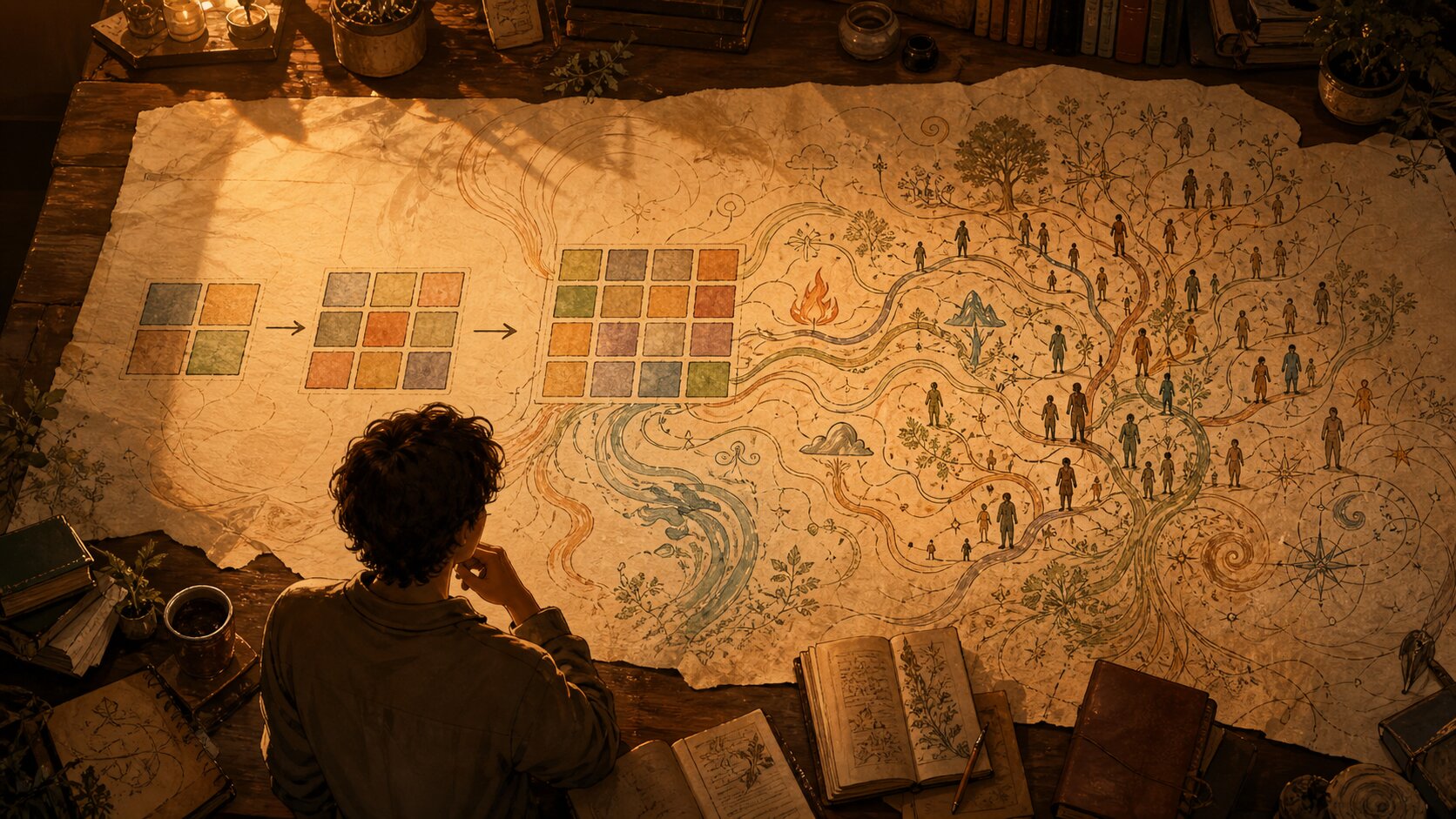
Most personality tests start with a number.
Four colors. Nine Enneagram types. Sixteen MBTI types. Five Human Design types. Five Big Five dimensions.
The number changes. The promise stays the same: "Here is the group you belong to. Here is the kind of person you are."
That can feel useful at first. A type gives language to something you may have felt for years. It can make you feel seen. It can make conversations easier. It can help you notice patterns in yourself and in other people.
But there is a cost.
The moment a model says, "You are this," part of you may start living inside the label. You notice what confirms it. You explain away what does not fit. You may even stop trying things because they do not sound like "your type."
That is where the map starts replacing the person.
The Problem With Boxes
Personality models are not useless. Some of them describe real patterns.
DISC can help a team talk about communication. The Enneagram can give people a language for motives and defenses. The Big Five has strong research behind it. Even MBTI, despite its problems, gives people a simple way to talk about differences they already feel.
The problem is not that these tools see nothing.
The problem is that they often see too little, then act as if they have seen the whole person.
A four-type model has to place billions of people into the same few boxes. A sixteen-type model is more detailed, but each box is still enormous. Even a more nuanced typology still has to compress millions of different lives into the same description.
And people are not boxes.
You can be quiet in groups and powerful in one-to-one conversations. You can be deeply emotional and sharply analytical. You can avoid attention and still have leadership inside you. You can love structure in one part of life and chaos in another.
A type usually struggles with that kind of contradiction.
A person does not.
Why Types Feel So Good
Types stay popular because they give something people genuinely want.
They give relief. "So that is why I am like this."
They give belonging. "There are other people like me."
They give a shortcut. "Now I know what career, partner, or role fits me."
There is nothing wrong with wanting that. Humans need language for themselves. We need mirrors. We need ways to compare experience.
But a type can quietly become more than a mirror. It can become a rule.
"I am an introvert, so I do not do public speaking."
"I am a Type 5, so I should stay detached."
"I am not a natural leader."
"I am too emotional for strategic work."
At first the label explains you. Later it may start limiting you.
That is the real danger. Not that a type is always false, but that it can become too convincing.
The Old Map Problem
Alfred Korzybski wrote that the map is not the territory.
That sentence matters here.
A personality model is a map. It simplifies reality so we can talk about it. That is useful. But the map is never the person.
If the map says you are introverted, that may describe a real tendency. But it does not know every room, every friendship, every season of your life, every situation where you suddenly become alive.
If the map says you are a thinker, it may describe one part of your style. But it does not mean your emotional life is secondary.
If the map says you are not a leader, it may only mean you do not lead in the loud, social, visible way the test expects.
The danger begins when the model stops being a tool and becomes an identity.
Then the person starts shrinking to fit the map.
Why More Detail Matters
Research keeps pointing toward a simple idea: personality works better when it is measured with more detail.
Broad traits can tell us something. But smaller patterns often tell us more. A person may not be "high" or "low" in a simple global sense. Their answers may shift depending on the situation, the relationship, the risk, the body, the goal, the pressure, and the meaning of the moment.
That does not mean people are random.
It means people are layered.
A simple type asks: "Which box are you in?"
A better question is: "What pattern appears when we look closely?"
That is why a model with more dimensions can be more useful. Not because complexity is impressive by itself. Complexity only matters when it helps us see something true that a simpler model would miss.
The Cost Of A Wrong Number
The cost of typing is practical.
If a test tells someone, "You are not a leader," that person may stop looking for their own form of leadership. But maybe their Fire is not absent. Maybe it is quiet. Maybe it shows up in crisis, in standards, in protection, in conviction, or in the ability to make a hard decision when everyone else freezes.
If a test says, "You are a thinker, not a feeler," it may force a false choice. A person can have strong Air and strong Water. They can think clearly and feel deeply. They can analyze without becoming cold. They can care without becoming irrational.
If a test says, "You are a stable type," it may miss the fact that the person changes across contexts. They may be grounded at work and scattered at home. Open with friends and closed with strangers. Brave in ideas and cautious in action.
The number is wrong because the person is bigger than the number.
Four is too small. Nine is too small. Sixteen is too small.
Even five broad dimensions are still only a sketch.
What WinnerScript Does Instead
WinnerScript does not start by asking, "Which type are you?"
It asks:
Where does your energy enter?
Where does it organize?
Where does it leave the body and become action?
Where does it flow easily?
Where does it get stuck?
Instead of putting a person into one category, WinnerScript looks at 48 instincts and senses across five elements and three phases. That creates a profile that is closer to a living map than a label.
The point is not to say, "This is who you are."
The point is to say, "This is one way your current pattern may be moving."
That difference matters.
A label closes the conversation. A map opens it.
A Name Is Not A Cage
WinnerScript may give a person an archetype name.
"The Constellation Architect."
"The Codebreaker."
"The Dormant Volcano."
But those names are not types in the old sense. They are not boxes. They are poetic handles for a pattern in one profile at one moment in time.
The name should help you remember the map, not replace it.
If it gives language, good.
If it starts limiting you, throw it away.
That is Maybe Logic. A model may be useful. It may be partly wrong. It may be useful because it is partly wrong in a clear way. The point is not to worship the map. The point is to navigate better.
You are not one of four types.
You are not one of nine types.
You are not one of sixteen types.
You are a moving configuration of instincts, senses, history, body, choice, context, and possibility.
Any model that forgets that is too small.
Maybe.
Personality types can be useful as first language, but they become dangerous when they turn into identity. WinnerScript uses 48 dimensions across five elements and three phases because people are too layered for one fixed box. The goal is not to replace one label with another. The goal is to build a better map, then remember that even the best map is still only a map.
- Marcin O., co-creator of WinnerScript